Why Your Feet Hurt Worse After You Sit Down, Not During the Shift
Quick Answer: During a shift, constant movement keeps blood and lymph fluid circulating and keeps your nervous system busy with competing signals. When you sit, the muscle pump stops, fluid pools in tissue that is already inflamed, and the distraction disappears. The pain was building for hours. Sitting is just when you finally notice it.
You got through nine hours on concrete and felt survivable. Then you sat down on the couch, and twenty minutes later your feet felt like someone had replaced the bones with hot gravel. That delay is not random, and it is not you being dramatic.

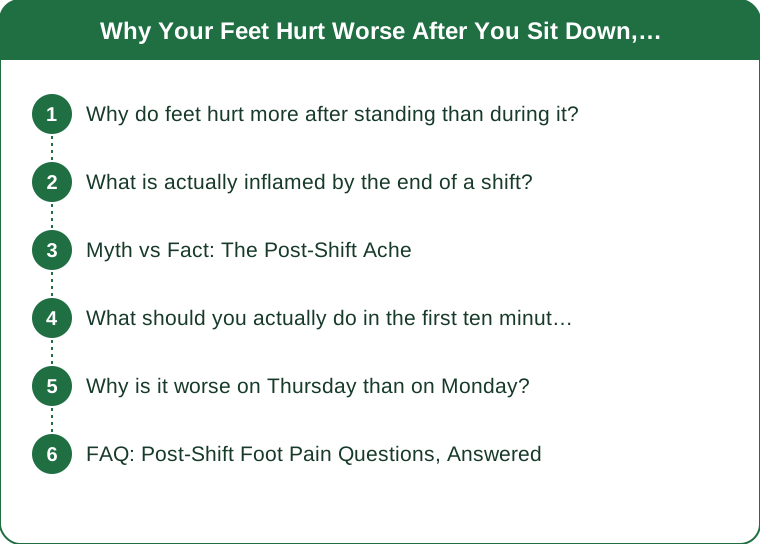
Why do feet hurt more after standing than during it?
Two systems are involved, and both switch off when you sit.
The first is the calf muscle pump. Every step compresses the veins in your lower leg and pushes blood and lymph fluid back up toward your heart. It is the reason walking all day swells your feet less than standing still all day does. The moment you stop moving, the pump stops, and fluid that was being actively moved uphill settles into the lowest tissue available.
The second is attention. During a shift your nervous system is filtering a huge volume of input: the task, the noise, the people, the next thing. Pain signals compete with all of it and lose. Sit in a quiet room and they no longer have competition.
So the sequence is: inflammation accumulates for hours, fluid pools within minutes of sitting, and your attention finally clears. The pain is not new. It is uncovered.
What is actually inflamed by the end of a shift?
Usually the plantar fascia and the small intrinsic muscles of the foot, plus the fat pad under the heel.
The plantar fascia is a thick band of connective tissue running from your heel to the base of your toes. It is not built to contract, only to resist stretch. Standing loads it in a low-grade way for the entire shift, and connective tissue responds to sustained load far more slowly than muscle does.
That slow response is why the ache lags. Muscle soreness shows up in hours. Fascial irritation shows up in a dull throb that peaks when load is removed and the tissue starts to cool and stiffen.
The heel fat pad matters too, and gets ignored. It is a shock-absorbing structure that compresses under load and needs time to rebound. After eight hours it is flattened, which is part of why the first steps you take after sitting feel worse than the last steps before you sat.
Myth vs Fact: The Post-Shift Ache
Myth: If it hurts after you sit, you sat wrong. Fact: Position matters less than elevation. Sitting with feet flat on the floor is worse for swelling than sitting with them raised, but neither one caused the underlying irritation.
Myth: Cold is always the right answer. Fact: Cold helps a genuinely inflamed, hot, swollen foot. It does very little for stiff, tired connective tissue, which usually responds better to gentle movement and warmth. Feel the foot. If it is puffy and warm, cool it. If it is just stiff and achy, move it.
Myth: The pain means you damaged something today. Fact: In most standing jobs the pain is cumulative loading, not acute injury. The tell is symmetry and timing. Both feet, worse late in the week, better after two days off, points to load. One foot, sharp, sudden, and not improving with rest points to something that needs a professional look.
Myth: Sitting down more during the shift fixes it. Fact: Short sits help, but only if you actually move your ankles while seated. A ten-minute sit with motionless feet lets fluid pool without giving the tissue any of the circulation benefit.

What should you actually do in the first ten minutes at home?
The window right after a shift is the highest-leverage ten minutes you have. Do these in order.
Walk barefoot for two minutes before you sit. Not a workout. Just let the foot move through a full range without the shoe’s support, on a soft surface if you have one. This keeps the pump running while the tissue cools.
Then elevate for ten minutes, feet above hip level. Not just up on a stool. Above the hips is where gravity starts working for you instead of against you. A couch armrest or two pillows is enough.
Do 20 slow ankle pumps while elevated. Point and flex, full range, about two seconds each way. This gives you the calf pump without the standing.
Then roll the arch for 60 seconds per foot. A ball, a frozen water bottle, whatever is there. Moderate pressure, slow. You are trying to restore glide between tissue layers, not punish anything.
Skip the immediate hot shower. Heat before elevation increases blood flow into a limb that is already congested, and people routinely report the ache getting worse for it.
Why is it worse on Thursday than on Monday?
Because connective tissue recovers on a longer timeline than the 14 or 15 hours between shifts.
Muscle glycogen refills overnight. Fascial irritation does not resolve overnight, so each shift starts from a slightly worse baseline than the last. By day four the accumulated deficit is large enough that the same workload produces noticeably more pain.
This is also why the fix that works is rarely a single heroic intervention. It is small deductions from the daily load: a second pair of shoes rotated in midweek so the cushioning and the pressure pattern change, a mat where you stand longest, and a genuine ten-minute elevation break somewhere in the middle of the shift rather than only at the end.
If Thursday is always the worst day, treat Wednesday as the intervention point, not Thursday.
This is general information, not medical advice. Pain that wakes you at night, numbness, or a foot that stays swollen after a full day off should be looked at by a clinician.
FAQ: Post-Shift Foot Pain Questions, Answered
Should I stretch my calves or my feet first?
Calves first. A tight calf increases the tension load running through the plantar fascia, so releasing it changes the input rather than just treating the output. Thirty seconds per side, then move to the arch.
Are compression socks worth it if the pain is in my feet, not my legs?
Often yes. Compression works on the fluid dynamics of the whole lower limb, and reducing pooling in the calf reduces how much settles in the foot. Graduated 15-20 mmHg is the usual starting range for standing work.
Why does the first step out of bed hurt most?
The fascia shortens and stiffens overnight while the foot is relaxed and pointed. The first step loads it before it has re-lengthened. Flex your foot and toes a few times before your feet touch the floor and most people notice a real difference within a week.
TL;DR:
- Movement keeps fluid circulating and pain signals suppressed; sitting removes both at once
- The irritation is connective tissue and the heel fat pad, which respond on a slow timeline
- Best ten minutes: walk barefoot 2 min, elevate above hip level 10 min, 20 ankle pumps, roll the arch
- Thursday is worst because recovery is slower than the gap between shifts, so intervene on Wednesday
The post-shift ache is a reporting delay, not a new injury. Change what happens in the first ten minutes at home and you change what Thursday feels like.
Keep Reading
This article is for general informational purposes only and is not medical advice. Always consult a qualified health professional for guidance specific to you.