Why Standing Fatigue Moves From Your Feet to Your Hips Over a Year
Quick Answer: Feet and calves adapt to standing load within a few months — the tissues get more tolerant and the discomfort fades. The hips and lower back do not adapt in the same way, because their problem is sustained position rather than load. As you unconsciously find a comfortable standing posture and hold it, the cost shifts upward to whatever is holding you there. The fix is varying position, not more support.
The first few weeks of a standing job are all about your feet. Everyone tells you to buy better shoes, and they are right, and it helps.
A year on, your feet barely register. But your lower back is tight by hour six, one hip aches on the drive home, and nobody warned you about that part.
Nothing has gone wrong. The load found somewhere new to go.

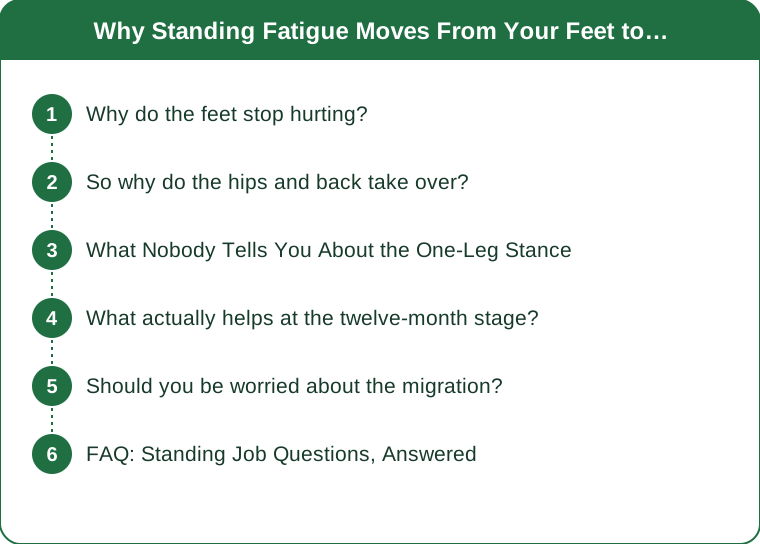
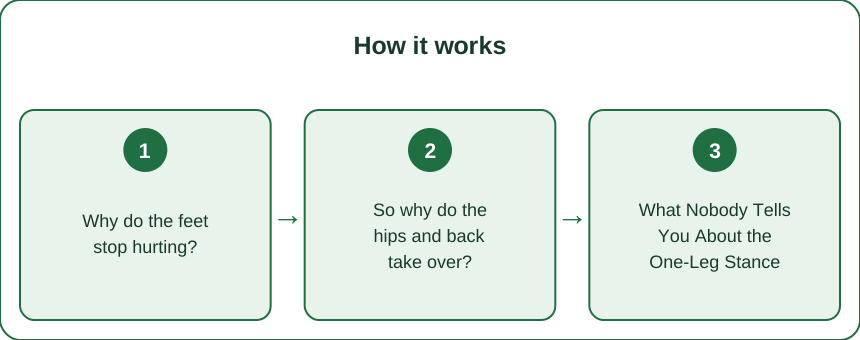
Why do the feet stop hurting?
Because they genuinely adapt, and fairly quickly.
Standing load is a repetitive mechanical stress, and connective tissue responds to repetitive stress by remodelling. Plantar fascia, the small muscles of the foot, and the Achilles tendon all become more tolerant of sustained load over roughly three to six months of consistent exposure.
The calves adapt too, and in a specific way: they become better at sustaining low-level contraction, which is what standing demands. This is a real fitness adaptation, just not one anybody celebrates.
Circulatory adaptation also occurs. The venous system in the lower leg becomes somewhat more efficient at handling prolonged upright posture, which is why the ankle swelling that was dramatic in month one is usually milder by month six.
What none of this means is that the total load went down. You are standing exactly as much as you were. The tissue that was complaining has stopped complaining. The load is still arriving, and it is still going somewhere.
So why do the hips and back take over?
Because their problem is a different one, and adaptation does not address it.
Feet suffer from load. Hips and backs suffer from stillness.
As you get more comfortable standing, you stop shifting around. Early on you fidget constantly because everything is uncomfortable. Later you find a position that works and you hold it — and holding it is precisely the problem.
Sustained postures have three costs that repeated movement does not:
- Static muscle contraction restricts its own blood flow. A muscle holding a low-level contraction for hours compresses the vessels running through it. It is working continuously and being supplied poorly, which is a fast route to the deep ache people describe in the lower back.
- Creep in connective tissue. Ligaments and fascia held at a constant length gradually deform, which reduces their passive support. This is why the last two hours of a shift feel disproportionately worse than the first two — the passive structures have been slowly giving way all day.
- Asymmetry compounds. Almost everyone has a preferred standing side — hip out, weight through one leg. Over a year, one hip abductor group is chronically shortened and the other chronically lengthened. This asymmetry is the single most common source of the one-sided hip ache people develop.
None of these get better with more foot cushioning, which is why the shoe that solved month one does nothing for month twelve.
What Nobody Tells You About the One-Leg Stance
The comfortable standing position is the one doing the damage, and it is comfortable precisely because it is passive.
When you stand with weight through one leg and the hip pushed out, you are hanging on passive structures rather than holding yourself with muscle. The hip joint capsule and the iliotibial band on the loaded side take the weight, and the abductors on that side switch largely off.
It feels restful because it is restful — for the muscles. The cost is transferred to tissue that is not designed for sustained loading and does not adapt well to it.
Nearly everyone has a strong side preference, and most people are unaware of which side it is until they are asked. The tell is which hip aches at the end of a shift, and it is usually the one you stand on.
The result after a year is a measurable difference between sides: tighter on one, weaker on the other, and a pelvis that sits slightly asymmetrically even when you are trying to stand square. This is also the most common reason standing workers develop one-sided lower back pain that no amount of core work resolves — the core is not the problem, the standing habit is.
The fix is embarrassingly simple and almost nobody does it: deliberately alternate sides. If you catch yourself on the right, switch to the left. It will feel wrong and slightly unstable, which is the whole point — it is the side that has not been doing the work.

What actually helps at the twelve-month stage?
Position variety, targeted mobility, and strength in the specific things that stillness degrades.
During the shift:
- A footrest, rail, or low box. Putting one foot up by 10 to 20cm unloads the lumbar spine considerably by reducing pelvic tilt. Alternate feet every ten minutes or so. This is the highest-value intervention available and most workplaces already have something that works.
- Deliberate side alternation. As above. Set a mental cue — every time you finish a task, switch sides.
- Micro-movements. Weight shifts, heel raises, a few steps. Twenty calf raises hourly both drives circulation and interrupts the static pattern.
- Change your working height if there is any option to. Even a small change in counter or screen height alters which structures are loaded.
Off shift, the two things that matter most:
- Hip flexor and lateral hip mobility. Standing with a hip pushed out shortens the lateral structures on that side. 30 seconds per side, twice, of a standing lateral lean and a half-kneeling hip flexor stretch addresses the majority of it.
- Glute medius strength. This is the muscle that switches off in the passive stance and it is the one that fails first. Side-lying leg raises, banded lateral walks, single-leg work — 3 sets of 12 per side, twice a week produces noticeable change within about six weeks.
What does not help at this stage: more cushioning, more supportive insoles, or a better anti-fatigue mat. All of these were the right answer in month one and are addressing a problem you no longer have.
Should you be worried about the migration?
Generally no, but there are specific patterns worth taking seriously.
Normal and expected: end-of-shift stiffness that eases within an hour of finishing, mild one-sided hip tightness, a lower back that feels tired rather than painful, symptoms that improve on days off.
Worth getting assessed: pain that persists overnight or is present on waking, pain that radiates down a leg below the knee, numbness or pins and needles, symptoms that no longer improve on days off, or anything that worsens progressively over weeks rather than fluctuating.
The pattern that most often gets ignored too long is one-sided hip pain that has been present for months at a level that is annoying but manageable. It rarely resolves on its own because the standing habit that causes it continues daily, and it responds well to specific strengthening once someone identifies which side is weak.
This is general information, not medical advice — persistent or worsening pain deserves a proper assessment rather than a self-managed programme.
FAQ: Standing Job Questions, Answered
Does this mean my expensive shoes were a waste?
No — they solved the month-one problem, and they are still preventing it from coming back. Foot comfort is a maintained state, not a permanent fix. The point is that shoes were never going to address a hip problem caused by holding a position.
Is a sit-stand arrangement better?
Yes, if you can genuinely alternate. The benefit comes from the change, not from either position. Sitting all day and standing all day produce different problems; alternating every 30 to 45 minutes avoids most of both.
Why does it feel worse on days off?
Common and slightly counterintuitive. On a shift you are moving constantly at low level, which keeps everything circulating. A still day off removes that without removing the accumulated stiffness. Twenty minutes of easy walking on a day off usually resolves it.
TL;DR: The load did not go away. It moved.
- Feet and calves genuinely adapt over three to six months. Hips and lower backs do not, because their problem is stillness rather than load.
- As you get comfortable, you stop shifting — and sustained posture restricts blood flow, deforms connective tissue, and builds side-to-side asymmetry.
- The passive one-leg stance is the main culprit, and it is comfortable because it is passive.
- Use a footrest and alternate feet, deliberately switch standing sides, and do 20 calf raises hourly.
- Off shift: lateral hip mobility and glute medius strength, 3 sets of 12 per side, twice a week.
More cushioning was the right answer in month one and is the wrong answer in month twelve.
Keep Reading
This article is for general informational purposes only and is not medical advice. Always consult a qualified health professional for guidance specific to you.