Why Your Work Shoes Fit at Hour Two and Hurt at Hour Seven
Quick Answer: Feet swell through a standing shift — commonly by a noticeable half size by the end of a long day — because gravity and static standing slow venous return. A shoe fitted to a morning foot becomes a tight shoe by hour seven. Fit shoes at the end of a shift, leave a thumb’s width at the toe, and use lacing you can loosen mid-shift.
At 9am the shoes are perfect. At 4pm your toes are numb, the sides are burning, and you are convinced these shoes are defective.
They are not defective. They fit a foot you no longer have. Foot volume changes across the day, and on a standing job the change is much bigger than most people realize.
Here is what happens, and how to size and manage around it.

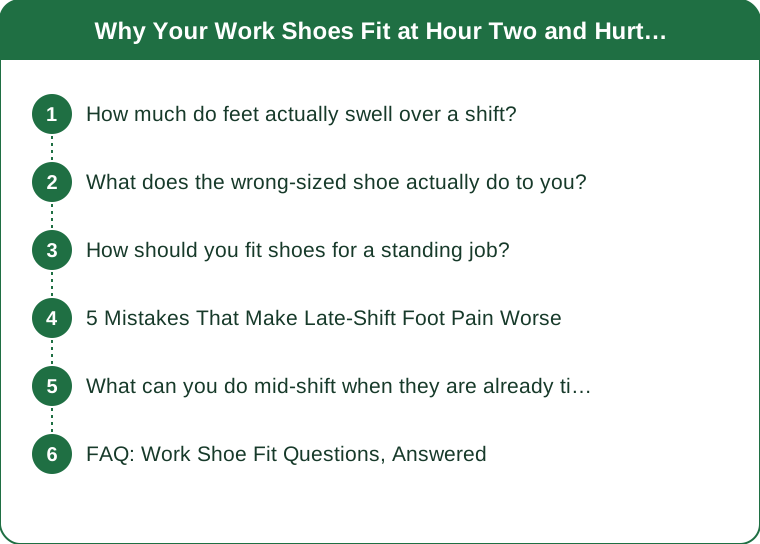
How much do feet actually swell over a shift?
Enough to change your shoe size.
Blood and interstitial fluid pool in the lower legs and feet whenever you are upright and relatively still. Standing without much walking is the worst case, because the calf muscle pump — the mechanism that pushes venous blood back up — only works when the calf contracts. Standing at a register or a bench barely engages it.
The result is a foot that is measurably longer, wider, and deeper by the end of the day. Half a size is a common, everyday amount. Heat makes it more; a long stretch on concrete makes it more; a day where you barely moved from one spot makes it more.
This is why the classic advice to buy shoes in the afternoon exists, and it applies double to standing work. If you tried the shoes on at 10am on a Saturday, you fitted them to your smallest foot of the week.
What does the wrong-sized shoe actually do to you?
It is not just discomfort — a shoe that becomes tight mid-shift causes a predictable chain of problems.
- Toe box compression produces the burning and numbness across the ball of the foot. Sustained pressure on the nerves between the metatarsals is the classic cause.
- The foot cannot splay on loading, so shock that should be absorbed by natural spread transfers up into the arch and then the lower leg.
- You change how you walk to avoid the pressure, usually by rolling to the outside or shortening your stride, which is how a shoe problem becomes a hip or knee complaint by Thursday.
- Circulation gets worse, which increases the swelling, which tightens the shoe further. It is a loop, and it accelerates in the last two hours.
The tell that it is a fit problem rather than a support problem: the pain is worse at the end of the shift and better in the first hour, every single day. Support problems tend to hurt more consistently.
How should you fit shoes for a standing job?
Fit them for your worst foot, not your best one.
- Try shoes on at the end of a shift, or after being on your feet for several hours. This is the single most important rule and it is the one people skip.
- Leave a full thumb’s width between your longest toe and the end of the shoe. Your longest toe is not always your big toe.
- Check width, not just length. Going up a half size to solve a width problem gives you a shoe that slides at the heel and still pinches. Many brands offer wide fittings; on a standing job it is often the right call.
- Wear the socks you actually work in. A thick work sock versus a thin liner is easily a third of the fit difference.
- Stand up in the store and let your foot load fully. Sitting-down fitting underestimates length by a surprising amount because the foot lengthens under body weight.
If you are between sizes at the end of the day, take the larger one and manage the volume with lacing and socks.

5 Mistakes That Make Late-Shift Foot Pain Worse
1. Lacing once in the morning and never touching it. Your foot changed volume three times since then. Re-lace at your break — loosening the two eyelets nearest your toes takes ten seconds and relieves most forefoot pressure.
2. Wearing the same pair every day. Foam needs 24 hours to rebound. Two pairs alternated last more than twice as long as one pair worn daily, and the second day in the same compressed midsole is noticeably worse.
3. Sitting completely still on break. Sitting stops the swelling from increasing but does very little to reverse it. Ten ankle pumps and a minute with feet up does far more than fifteen minutes of sitting normally.
4. Compression socks that stop below the calf. A sock that ends mid-calf with a tight band can act as a tourniquet. Either go proper knee-high graduated compression or do not bother.
5. Buying the shoe that felt “snug and supportive” in the store. Snug in the morning is tight by afternoon. Supportive should come from the structure of the shoe, not from the shoe squeezing your foot.
What can you do mid-shift when they are already tight?
You cannot un-swell a foot at hour seven, but you can take pressure off it.
- Loosen the forefoot lacing and re-tighten across the instep. You want the shoe held at the midfoot and free at the toes. This one change fixes more end-of-shift pain than any insole.
- Take the shoes off for two minutes on break if you can. Even brief unloading lets some fluid redistribute.
- Elevate whatever you can, however you can. Feet on a low crate, or lying down for five minutes, both work. Above heart level is ideal and rarely available at work.
- Do 20 calf raises before the last hour. You are manually operating the pump that standing still switched off. It feels counterintuitive to add work to tired legs, and it genuinely helps.
- Hydrate and go easy on the salt at lunch. Both influence how much fluid you are holding, and lunch is close enough to the bad hours to matter.
FAQ: Work Shoe Fit Questions, Answered
Should I just buy a size up for work?
Often yes, but do it with the right method — size up based on an end-of-day fitting, not as a guess. A shoe that is simply too big causes heel slip and blisters. The goal is a shoe that fits your afternoon foot and can be laced snug for your morning foot, which is exactly backwards from how most people buy.
Do insoles help with swelling-related pain?
Insoles help with arch support and pressure distribution, not with volume. In fact a thick aftermarket insole reduces the space in the shoe and can make late-shift tightness worse. If you use one, remove the factory insole first and re-check the fit at the end of a day.
When is swelling a medical issue rather than a shoe issue?
Normal work swelling is roughly symmetrical, comes on through the day, and is largely resolved by the next morning. See a professional if one leg swells much more than the other, if it is painful, warm, or red, if it does not settle overnight, or if it comes with shortness of breath. This is general information, not medical advice.
TL;DR:
- Your feet get measurably bigger over a standing shift — commonly about half a size — because standing still switches off the calf pump.
- Fit work shoes at the end of a shift, in your work socks, standing up, with a thumb’s width at the toe.
- Late-day burning and numbness that improves overnight is a fit problem, not a support problem.
- Re-lace at your break: loose at the toes, snug across the instep.
- Alternate two pairs, do calf raises before the last hour, and elevate whenever you get the chance.
The shoes you bought on a Saturday morning were never going to work on a Wednesday afternoon. Fit them to the foot that has to survive hour seven, and the rest of the shift stops being an endurance event.
Keep Reading
This article is for general informational purposes only and is not medical advice. Always consult a qualified health professional for guidance specific to you.