Why Standing Still Is Harder on Your Legs Than Walking All Day
Quick Answer: Walking uses your calves as a pump that pushes blood back up your legs. Standing still switches that pump off while gravity keeps working. Blood and fluid pool below the knee, pressure builds in the tissue, and the same muscles stay contracted at a low level for hours without ever relaxing. The fix is not endurance - it is movement small enough to do at your station: weight shifts, heel raises, and one foot elevated on a low rail.
Static standing is genuinely harder physiologically than easy walking, and that is not a fitness problem.
It is a circulation problem with a mechanical solution.

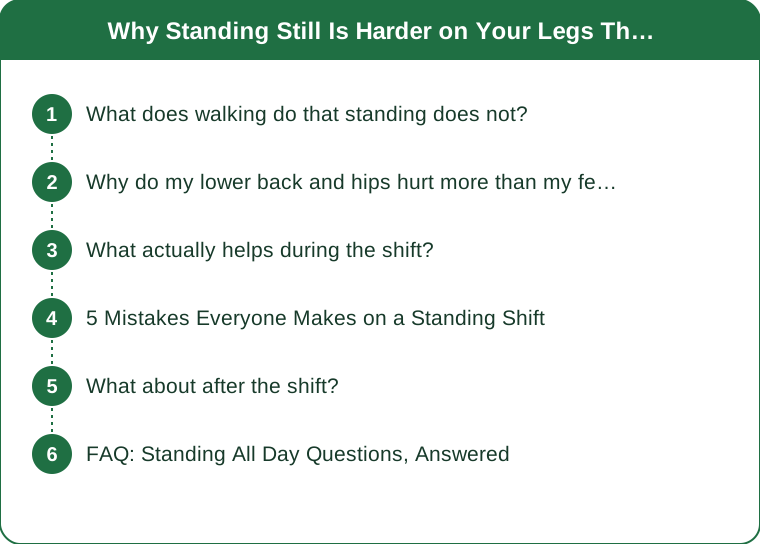
What does walking do that standing does not?
It runs the pump in your calves.
Your calf muscles function as a secondary heart for the lower body. Every contraction squeezes the deep veins and pushes blood upward; one-way valves keep it from falling back. Walking cycles that pump roughly 100 times a minute.
Standing still switches it off. The muscles hold a low-level contraction to keep you upright, but they never fully relax, so there is no squeeze-and-release cycle. Blood pools. Fluid moves out of the vessels into the surrounding tissue. Lower legs measurably swell over the course of a shift.
That swelling is what you feel as heaviness, and it is also why your shoes fit at hour two and hurt at hour seven.
There is a second, less obvious cost. A sustained low-level contraction fatigues small motor units without ever recruiting the larger ones, which is a pattern the body handles poorly. Researchers have long noted that continuous low-level muscle activity causes disproportionate fatigue and discomfort compared to intermittent higher-level activity. Constant and small beats occasional and large, in the wrong direction.
Why do my lower back and hips hurt more than my feet?
Because static standing loads the spine in a way walking never does.
Walking constantly changes which structures are bearing load. Each step shifts weight, rotates the pelvis slightly, and alternates the muscles doing the work. Standing still leaves the same tissues loaded for hours.
Most people also drift into a fixed posture. Weight settles onto one hip, the pelvis tilts, and the lumbar spine takes a sustained asymmetric load. The hip you favor is doing most of the work all shift.
And the abdominal wall disengages. Prolonged standing tends toward an anterior pelvic tilt with the low back doing the stabilizing that deeper muscles should share.
The tell: if the pain is worse when you have been still than when you have been busy, the problem is the stillness, not the standing. People with the most physically demanding, moving-around jobs frequently report less discomfort than people whose job keeps them planted in one square meter.
What actually helps during the shift?
Small, frequent, and specific. None of this requires a break.
Weight shifts every few minutes. Alternate which leg carries the load. Deliberately alternating beats standing evenly, because even loading still means both legs are static.
Heel raises - 10 to 15, several times per shift. This is the single most effective intervention because it directly runs the calf pump. Do them while you are doing something else with your hands.
One foot up on a low rail or box, alternating. This is why bars have foot rails. Elevating one foot 4-6 inches unloads the low back and shifts the pelvis out of a fixed tilt. Swap feet every 15 minutes.
Walk 20 steps every half hour if the job allows. Even a short circuit resets circulation more effectively than standing still for the whole hour and then sitting for ten minutes.
Graduated compression socks, 15-20 mmHg. These directly counter the fluid pooling and are well supported for exactly this problem. Put them on before the shift, not when your legs already feel heavy - they work by preventing swelling, not by reversing it.
And do not lock your knees. A locked knee hangs on the joint structures and stops the muscle pump completely. Keep a soft, barely visible bend.

5 Mistakes Everyone Makes on a Standing Shift
1. Sitting for the entire break. It feels right and it is only half the answer. Ten minutes seated does not clear pooled fluid - the legs need to be elevated or the calf pump needs to run. Sit with your feet up on a chair, or spend two minutes of the break walking.
2. Wearing the same shoes every day. Foam needs 24 hours to decompress. Alternating two pairs makes both last longer and both feel better, and it changes the pressure points day to day.
3. Buying shoes in the morning. Feet swell over the day. Shoes fitted at 9 a.m. are the wrong size for hour seven. Try them on in the evening.
4. Cutting back on water to avoid bathroom trips. Dehydration makes circulation worse and swelling no better. This trade is a straight loss.
5. Waiting until it hurts to move. All of the interventions above are preventive. Heel raises at hour one work; heel raises at hour seven are damage control. Set a quiet reminder for the first half of the shift, which is the half people neglect.
What about after the shift?
The recovery window matters more than most people realize, and it is short.
Elevate your legs above heart level for 10-15 minutes. Lying on the floor with your calves on a couch is the classic and it works. This is the fastest way to clear the fluid that accumulated all day, and doing it early beats doing it at bedtime.
Walk for five minutes before you drive. Going straight from standing to sitting keeps the pump off during exactly the period your legs need it on.
Move your ankles in circles at every red light. Trivial, and it does more than it sounds like.
Skip the very hot shower on a heavy-legged day. Heat dilates vessels and can make swelling feel worse in the short term. Cool or contrast finishing is better if your legs are genuinely swollen.
And watch the weekly pattern. If Thursday is always the worst day, that is accumulated fluid and accumulated tissue fatigue, not a Thursday problem. The intervention belongs on Monday and Tuesday, when it feels unnecessary.
FAQ: Standing All Day Questions, Answered
Are anti-fatigue mats actually worth it?
Yes, where you can use one. They work by encouraging constant micro-adjustments in the foot and ankle, which keeps the calf pump partly active. The benefit is real but modest, and it does not replace deliberate movement.
Do compression socks work if I already have swelling by noon?
They work far better as prevention. Put them on before the shift starts. If your legs are already swollen, elevate first for 10 minutes, then put them on.
Is it normal for one leg to swell more than the other?
Mild asymmetry from favoring one hip is common. Persistent one-sided swelling, warmth, or pain in one calf is a different matter and worth getting checked. This is general information, not medical advice.
TL;DR:
- Walking runs the calf pump; standing still shuts it off while gravity keeps pooling fluid downward.
- Heel raises and alternating weight shifts are the highest-value interventions and take seconds.
- Put one foot up on a low rail, alternating every 15 minutes, to unload the low back.
- Graduated compression socks prevent swelling - they must go on before the shift, not after.
- Elevate your legs for 10-15 minutes right after work, before you sit down for the evening.
Pick one thing to do at hour one of your next shift rather than hour seven. The whole point is that it should feel unnecessary when you do it.
Keep Reading
This article is for general informational purposes only and is not medical advice. Always consult a qualified health professional for guidance specific to you.