Why Your Feet Hurt More on the First Shift Back Than on the Fifth
Quick Answer: The first shift back after a day off often hurts most because tissue that had adapted to continuous loading partially resets, fluid redistribution has to restart, and your shoes have re-formed to an unloaded foot. Meanwhile a rest day spent sitting does little for the vascular side of standing fatigue. The fix is not more rest, it is loaded movement on the day off and a 10 to 15 minute walk before the shift starts rather than after.
You had a day off. You did nothing, deliberately.
And hour three of the next shift feels worse than any hour of the four-day stretch before it.
It is not that you got unfit in a day. Something more specific happened.

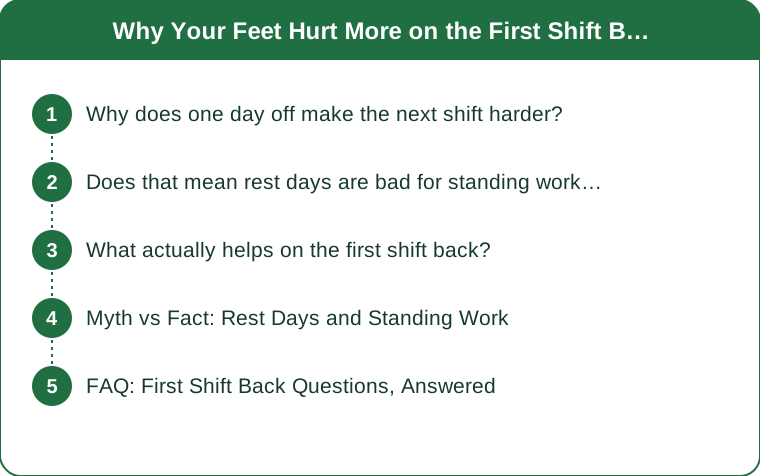
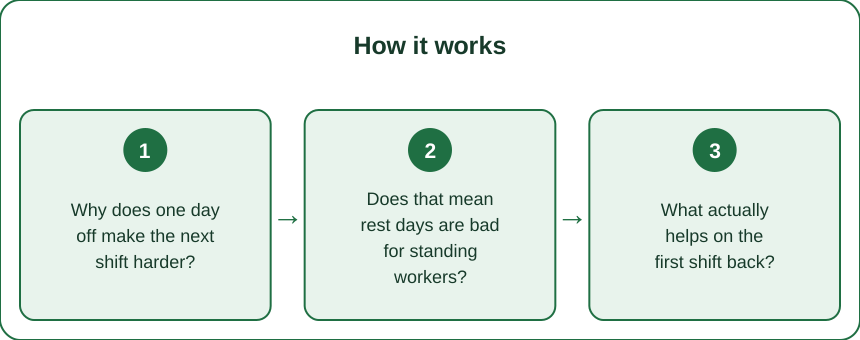
Why does one day off make the next shift harder?
Because standing tolerance is a set of short-term adaptations, and short-term adaptations are exactly the kind that fade fastest.
Plantar tissue adapts to daily loading. The fascia and fat pad of the foot respond to consistent load with changed stiffness and fluid content. A day of unloading partially reverses that, and the first re-loading day is the one that reports it.
Vascular tone resets. Standing for hours trains your venous return system to work against gravity for long periods. That adaptation is measured in days, not months, so a full day sitting genuinely reduces it.
Fluid pooling restarts from a different baseline. After a day of varied posture, lower-leg fluid distribution is different at the start of the shift than it is on day three of a run of shifts, when the pattern is established.
Your shoes decompress. Foam midsoles recover height and shape over 24 hours of no load. It feels like a fresh shoe, and a shoe that has changed shape sits differently against a foot shaped by four days of work.
Sleep pattern often shifts on days off. Later nights and later mornings mean the first shift back frequently follows worse-quality sleep, which lowers pain tolerance measurably.
And you notice more. After a break, the contrast is sharp. On day four of a run, discomfort is background. On day one it is news.
Does that mean rest days are bad for standing workers?
No. It means passive rest days are inefficiently spent.
Complete rest addresses the wrong system. The dominant driver of standing fatigue is circulatory, not muscular. Sitting still all day does very little for circulation and can leave you worse off.
Movement is the actual recovery tool here. A 30 to 45 minute easy walk on a day off does more for the next shift than an extra three hours on the sofa. Calf contraction is the pump that clears pooled fluid.
Elevation still helps, but at the right time. 15 minutes with your legs above hip height in the evening is genuinely effective. All day is not.
Keep some load in the foot. Barefoot around the house, some easy walking, a few sets of calf raises. The goal is to avoid a full unloading reset.
Do not save all your errands for the day off. Four hours of shopping is not a rest day, it is a shift with worse shoes. This is the single most common way standing workers arrive at their next shift already fatigued.
Sleep is the exception worth protecting. If you do one passive thing on a day off, make it a normal bedtime rather than a lie-in. Shifted sleep is a large part of why the first day back is rough.

What actually helps on the first shift back?
Front-load everything. The first two hours decide the shift.
Walk 10 to 15 minutes before you start. Not after. This primes venous return before you begin standing still, and it is the highest-return single change most standing workers can make.
Wear the shoes you finished the last run in, not the freshest pair. A shoe that matches your current foot shape beats a decompressed one on the first day back.
Compression socks on day one specifically. If you only wear them sometimes, the first shift back is the day they earn their money.
Move every 20 to 30 minutes, deliberately. Weight shifts, calf raises, a short walk. Standing still is harder on the legs than walking, and this is truest early in a shift.
Do not add the mat on day one. If you are trialling an anti-fatigue mat, day one back is a bad test day because everything else is already different.
Late-summer note: heat compounds all of this by increasing peripheral pooling. On a warm first-shift-back day, hydration and an earlier pre-shift walk matter more than usual, and the difference between a good and bad shift is often decided before you clock in.
Myth vs Fact: Rest Days and Standing Work
Myth: The first shift back is hard because you lost fitness
Fact: One day changes nothing about your fitness. It changes tissue loading state, vascular tone and shoe shape.
Myth: More sitting on a day off means more recovery
Fact: Sitting does little for the circulatory side of standing fatigue. Easy walking recovers you faster than sitting does.
Myth: New shoes are best worn on your freshest day
Fact: Break new shoes in on a run of shifts, not on the first day back, when your feet are already adjusting to everything else.
Myth: Sore feet at the start of a shift mean you should rest more
Fact: It usually means the previous rest was too passive, not too short.
Myth: Elevation is always good
Fact: Effective in a 15 to 20 minute block. All-day elevation reduces the muscular pumping that clears fluid in the first place.
Myth: It evens out by day two anyway, so ignore it
Fact: True that it eases, but the first shift back is also when most standing-work injuries and stumbles happen, so it is worth managing rather than enduring.
FAQ: First Shift Back Questions, Answered
How long does the first-shift-back effect last?
Usually one shift. By the second, tissue loading and vascular tone are back near their working baseline.
Is a pre-shift walk really better than a post-shift one?
Do both if you can, but the pre-shift walk changes the shift you are about to work. That is the higher-value one.
Should I rotate shoes across a run of shifts?
Yes, and the standard advice holds, but keep your most broken-in pair for the first day back specifically.
Do compression socks lose effect if worn every day?
No, they do not habituate. The reason to prioritise the first day back is simply that it is the highest-need day.
What if my day off is spent on my feet anyway?
Then it is not a rest day, and you should expect a cumulative rather than a reset pattern. Plan calf and foot recovery accordingly.
When should I see someone about it?
If first-step morning pain persists beyond 20 minutes, or if pain is sharp and localised rather than diffuse, get it looked at. This is general information, not medical advice.
TL;DR:
- The first shift back is hardest because tissue loading, vascular tone and shoe shape all partially reset.
- Passive rest addresses the wrong system; the driver of standing fatigue is circulatory.
- Spend part of a day off walking easily and keep some load in the foot.
- Walk 10 to 15 minutes before the shift, not just after.
- Wear your most broken-in shoes and compression socks on day one specifically.
One pre-shift walk on your next first-day-back will tell you more than any product will.
Keep Reading
This article is for general informational purposes only and is not medical advice. Always consult a qualified health professional for guidance specific to you.