Why Standing All Day Can Tire Your Legs More Than an Actual Workout
Quick Answer: Standing fatigue comes mainly from static muscle contraction restricting blood flow over long periods, while workout fatigue comes from dynamic muscle work followed by recovery. Static standing keeps calf and postural muscles slightly contracted for hours with no movement-driven circulation, which drains legs differently — and often more — than an intense but time-limited workout.
You did a full leg workout yesterday and recovered fine, but an 8-hour standing shift today has your legs feeling more wrecked than the workout did — that’s a fair comparison, and standing genuinely can be harder on circulation.

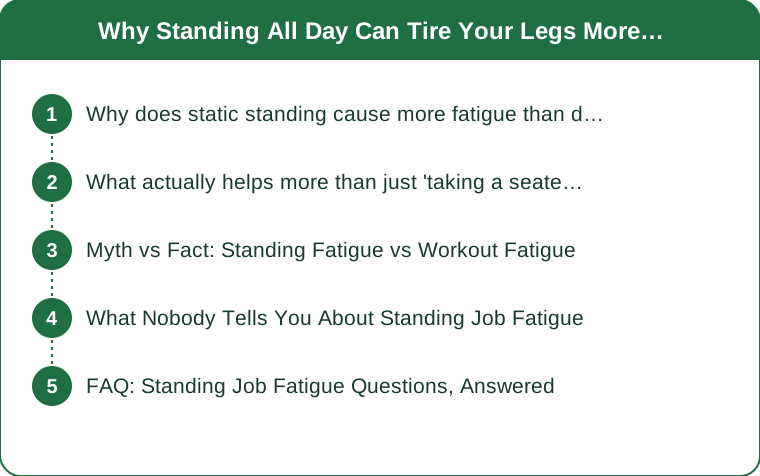
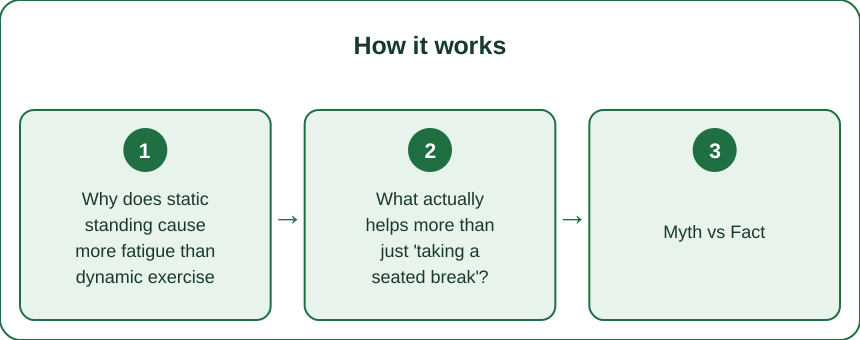
Why does static standing cause more fatigue than dynamic exercise in some ways?
Static muscle contraction — holding a position without movement — restricts blood flow in a sustained way that active, dynamic movement (like walking or lifting) doesn’t. During a workout, muscles contract and relax rhythmically, which actually helps pump blood back toward the heart; standing still keeps postural muscles in low-level constant tension without that pumping action.
This is why standing fatigue often shows up as heaviness, swelling, and aching rather than the localized muscle soreness (DOMS) you’d get from a workout — it’s a circulation issue layered on top of muscular fatigue, not just muscle overuse.
What actually helps more than just ‘taking a seated break’?
Micro-movement while standing — shifting weight, calf raises, brief walking breaks — restores some of the muscle-pump circulation that static standing removes, often more effective than a seated break alone. Compression socks also directly counteract the blood pooling that static standing causes in the lower legs.
Anti-fatigue mats reduce the constant postural micro-adjustments your feet and calves make on hard flooring, which adds up over an 8-hour shift even if each individual adjustment feels negligible.

Myth vs Fact: Standing Fatigue vs Workout Fatigue
Myth: Since standing isn’t ‘exercise,’ it shouldn’t cause real fatigue. Fact: Static postural fatigue is a distinct physiological process from exercise fatigue, and it can be just as draining, especially over long shifts.
Myth: Sitting briefly fully resets standing-related leg fatigue. Fact: Brief sitting helps somewhat, but active micro-movement (walking, calf raises) restores circulation more effectively than passive sitting alone.
Myth: Compression socks are just for medical conditions, not everyday standing jobs. Fact: Compression socks directly address the blood-pooling mechanism behind standing fatigue and are commonly recommended for anyone on their feet for long shifts.
What Nobody Tells You About Standing Job Fatigue
Standing on the same small patch of floor is worse than standing while moving around a similar amount, even at the same total time on your feet — the micro-movement of walking between tasks meaningfully reduces the static-contraction fatigue compared to standing rooted in one spot.
Most people notice standing fatigue peaks in the final 1-2 hours of a shift specifically, since blood pooling and swelling compound cumulatively across the day rather than staying constant from the first hour.
FAQ: Standing Job Fatigue Questions, Answered
Do anti-fatigue mats actually make a measurable difference?
Yes — they reduce the postural micro-adjustments needed on hard flooring, which adds up meaningfully over a full shift.
Is it better to sit briefly or walk briefly during a standing-job break?
Walking briefly is generally more effective at restoring circulation than sitting, though both help more than remaining static.
Should I be concerned if my legs swell noticeably by end of shift?
Mild swelling that resolves overnight is common with standing jobs; swelling that doesn’t resolve or comes with pain is worth mentioning to a doctor. This is general information, not medical advice.
TL;DR:
- Static standing restricts circulation in a way dynamic workout movement doesn’t, causing a different kind of fatigue
- Micro-movement and compression socks address the blood-pooling mechanism directly
- Standing rooted in one spot is worse than standing while moving between tasks
- Fatigue typically peaks in the final 1-2 hours of a long standing shift
Your legs aren’t weak for being more tired after standing than after a workout — the two are draining you through entirely different mechanisms.
Keep Reading
This article is for general informational purposes only and is not medical advice. Always consult a qualified health professional for guidance specific to you.