The Real Reason Standing All Day Is So Exhausting, and It's Not Just Your Feet
Quick Answer: Standing still for extended periods is more fatiguing than walking or moving because static standing requires continuous, low-level postural muscle contraction to maintain balance and prevent blood pooling in the legs, which is metabolically demanding in a way that rhythmic movement isn’t — the fatigue is driven as much by the postural and circulatory system working overtime as by the feet themselves, which is why brief movement breaks help more than resting completely still.
The exhaustion from a full day on your feet isn’t primarily a foot problem — it’s a whole-body circulatory and postural-muscle problem that just happens to show up as foot soreness first.

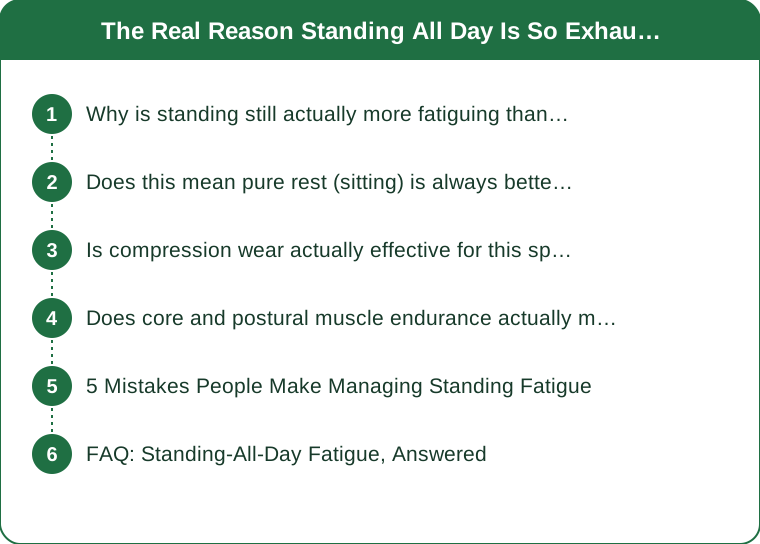
Why is standing still actually more fatiguing than walking around, even though walking is more physically active?
Static standing requires continuous, low-level contraction of postural stabilizer muscles throughout the legs, core, and back to maintain balance against gravity without the rhythmic muscle pump that walking naturally provides. Walking’s alternating muscle contractions actively help pump blood back up from the legs, while static standing doesn’t get this same circulatory assist, causing blood and fluid to pool more in the lower legs during standing than during walking.
Does this mean pure rest (sitting) is always better than standing during a break?
For circulation specifically, yes — sitting or, even better, brief walking breaks restore circulatory flow more effectively than continuing to stand still, even during a designated break. A break spent leaning against something while still upright provides less genuine circulatory relief than a break spent actually off the feet or moving.
Is compression wear actually effective for this specific standing fatigue, separate from the foot-soreness aspect?
Yes, meaningfully — graduated compression garments improve venous return, directly countering the blood-pooling effect that static standing causes, which addresses the circulatory root of standing fatigue rather than only cushioning the feet. This is part of why compression socks specifically help standing-job fatigue more than cushioned insoles alone.

Does core and postural muscle endurance actually matter for reducing standing fatigue, or is that overstated?
It matters genuinely — since static standing relies heavily on postural stabilizer endurance, people with weaker core and hip stabilizer endurance tend to fatigue faster during standing shifts, independent of foot-specific factors. General core and lower-body endurance training can measurably improve standing tolerance over time, beyond just addressing footwear.
5 Mistakes People Make Managing Standing Fatigue
Treating it purely as a foot problem — ignoring the circulatory and postural component misses half the actual cause.
Standing completely still during breaks — this doesn’t restore circulation the way sitting or brief movement does.
Skipping compression wear — this specifically addresses the venous return issue that cushioned shoes alone don’t.
Ignoring core and stabilizer endurance training — general fitness training genuinely improves standing tolerance over time.
Wearing the same shoes for an entire long shift — rotating between two shoe options mid-shift redistributes pressure points and reduces cumulative strain.
FAQ: Standing-All-Day Fatigue, Answered
How often should movement breaks be taken during a standing shift?
A brief two-to-three minute walk roughly every hour is a reasonable general target for restoring circulation, even on jobs where a full seated break isn’t frequently possible.
Does anti-fatigue matting actually address the circulatory component, or just cushioning?
Anti-fatigue matting primarily reduces cumulative joint and foot impact, and while it indirectly encourages small postural shifts that help circulation slightly, it doesn’t replace the benefit of an actual movement break.
Is standing fatigue a sign of an underlying health issue, or is it just normal for the job?
Mild, typical end-of-shift fatigue is normal, but significant swelling, discoloration, or pain that doesn’t improve with rest is worth mentioning to a healthcare provider. This is general information, not medical advice.
TL;DR:
- Static standing is metabolically demanding because it requires continuous postural muscle contraction without walking’s rhythmic assist
- Standing still doesn’t pump blood back from the legs the way walking does, causing more pooling and fatigue
- Compression wear and brief movement breaks address the circulatory root cause more directly than footwear alone
- Core and stabilizer endurance training genuinely improves standing tolerance over time
Standing-all-day exhaustion is a whole-body circulatory and postural issue wearing a foot-pain disguise — addressing the real mechanism works better than treating it as a shoe problem alone.
Keep Reading
This article is for general informational purposes only and is not medical advice. Always consult a qualified health professional for guidance specific to you.