Why Your Feet Hurt More on Concrete Than on Carpet at Work
Quick Answer: Concrete and similarly hard flooring return nearly all impact force back into the feet and joints with each step, while carpet and cushioned flooring absorb a meaningful portion of that force — over a full shift, that difference compounds into a noticeably higher pain level on hard surfaces even at identical standing duration.
If a shift on a hard sales floor leaves your feet far more sore than a similar shift on carpet, the surface itself explains most of that gap.

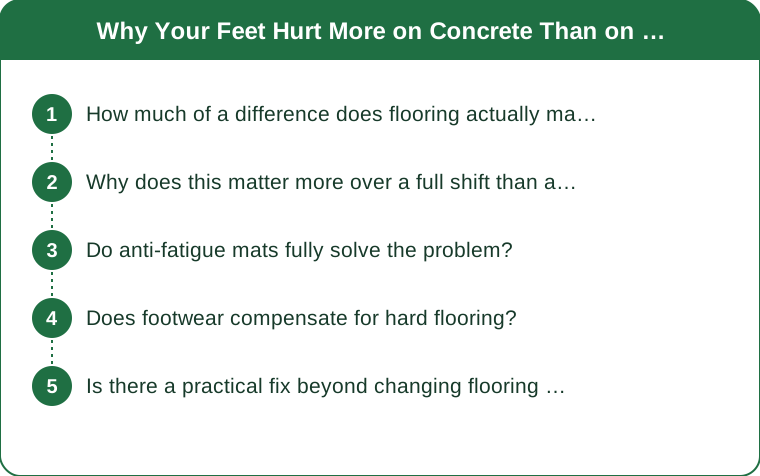
How much of a difference does flooring actually make?
Studies on occupational standing consistently find harder flooring correlates with measurably higher reported foot, leg, and lower back discomfort compared to cushioned flooring over comparable shift lengths. The body absorbs the shock that the floor doesn’t, and concrete absorbs almost none of it.
Why does this matter more over a full shift than a short period?
Impact force differences per step are small, but they compound across the thousands of steps and stationary-standing hours in a typical shift, which is why the pain gap becomes noticeable by the later hours rather than early on.

Do anti-fatigue mats fully solve the problem?
They help meaningfully but don’t fully replicate the cushioning of a well-padded carpet or built-up flooring system, particularly for the areas of a workspace where mats aren’t practical to place, like walkways between fixed standing zones.
Does footwear compensate for hard flooring?
Partially — supportive, cushioned footwear reduces but doesn’t eliminate the flooring effect, since shoe cushioning and floor cushioning address impact absorption at different points in the chain and work best combined rather than as substitutes for each other.
Is there a practical fix beyond changing flooring or shoes?
Shifting weight and position periodically — a slight stance change every 20-30 minutes — reduces the sustained pressure on any single point of the foot, which matters more on unforgiving surfaces where static standing concentrates strain in the same spots repeatedly.
TL;DR:
- Hard flooring returns impact force to the feet that cushioned flooring absorbs
- The difference compounds across a full shift rather than showing up early
- Anti-fatigue mats help but don’t fully replace better flooring or footwear
- Small position shifts every 20-30 minutes reduce concentrated strain
This is general information, not medical advice — ongoing foot pain that doesn’t ease after a shift is worth discussing with a professional.
Keep Reading
This article is for general informational purposes only and is not medical advice. Always consult a qualified health professional for guidance specific to you.